
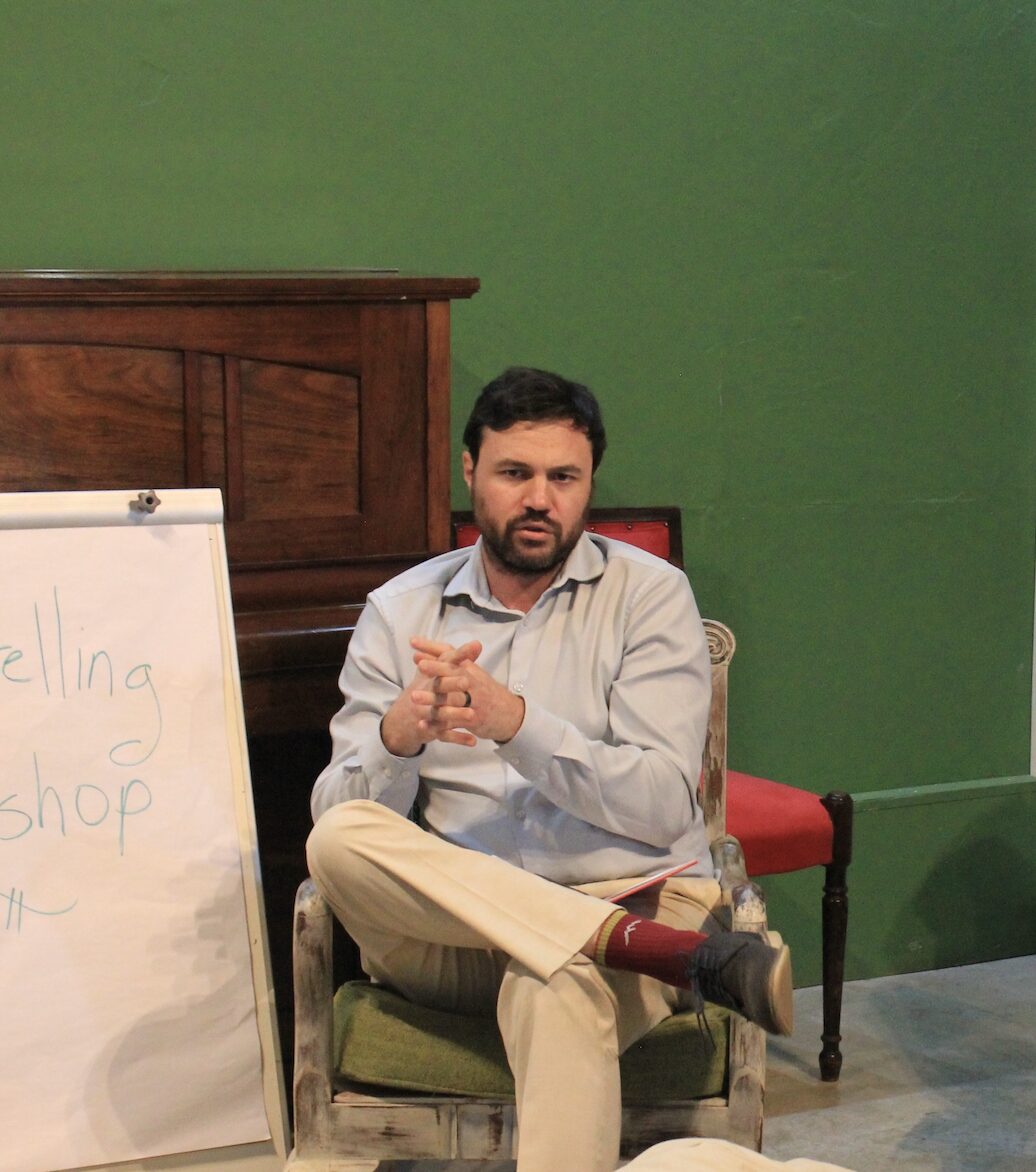
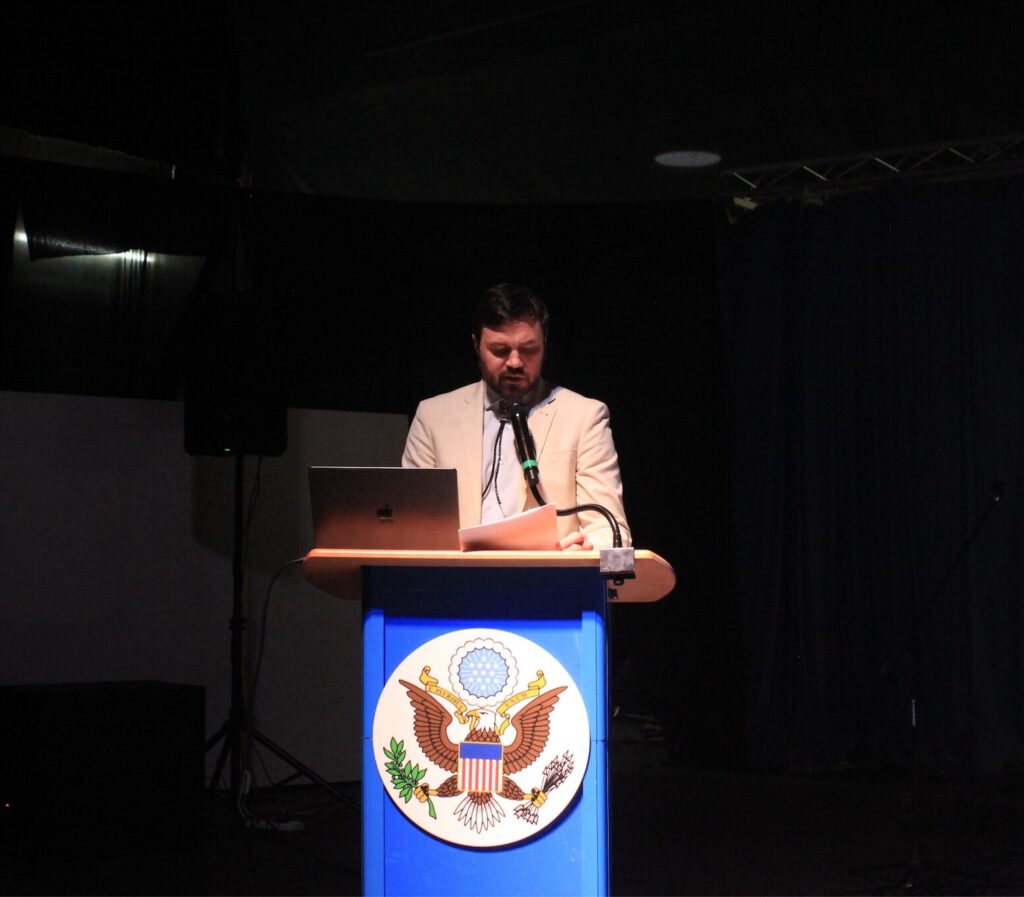
In May 2026, amid the creative energy surrounding the MTN Bushfire Festival, the Eswatini Theatre Club (ENTC) hosted a vital conversation on heritage, sustainability, and community. As part of the USA Embassy Eswatini’s Freedom 250 Commemorations, Mr Charlie Lockwood, Director of the Museum of International Folk Art (MOIFA) in Santa Fe, New Mexico, delivered a keynote address exploring Arts, Culture, Heritage Preservation and Sustainable Cultural Ecosystems.
Foregrounding this significant exchange, Afropolitan Explosiv played an active, direct role in the proceedings. Represented by its director, the interdisciplinary scholar and composer Dr Thokozani Mhlambi, the organization was invited to join the United States Embassy delegation, participating in Lockwood’s extensive cultural tour and situation assessment across Eswatini. This collaboration anchored the international dialogue within crucial regional artistic contexts and ongoing cross-border initiatives like our own Southern African Creative Corridor project.
Drawing from his experiences as a public folklorist, ethnomusicologist, museum professional, and cultural administrator, Lockwood offered a rich, data-driven analysis of how robust systemic infrastructure can safeguard living traditions and empower local communities.
Redefining Heritage: Beyond Static Relics
A central pillar of Lockwood’s address was the reframing of how we view traditional arts. Rather than treating culture as a collection of static relics frozen in the past, he argued that folk and traditional arts are vital, dynamic “ways of knowing, being and creating” that connect communities across generations.
Culture, Lockwood argued, survives most effectively when nurtured by strong, interconnected ecosystems rather than left to isolated, fragmented efforts. For traditions to endure, they demand continuous participation, transmission, and robust structural support.
Lessons from the US: Cultivating Collective Memory & Public Policy

Reflecting on the United States’ upcoming Freedom 250 commemorations in 2026, Lockwood highlighted how deeply cultural heritage, collective memory, and civic participation are woven into national sustainability.
A substantial portion of his presentation illustrated this through the lens of State Folklife Programmes in the US. Emerging around the 1976 U.S. Bicentennial celebrations, these institutional frameworks were designed to recognize, document, and financially support the cultural traditions of diverse and historically underserved populations—including rural communities, immigrant groups, and Indigenous populations.
These state programmes systematically support:
- Traditional artist apprenticeships
- Cultural festivals and public events
- Documentation and archival work
- Professional development and business skills for cultural practitioners
- Community-based preservation initiatives
Lockwood highlighted research from the National Endowment for the Arts (NEA) proving that folk and traditional arts programs are among the single most effective mechanisms for reaching and uplifting marginalized communities affected by poverty or geographic isolation.
The Tangible Economic Impact of Arts & Culture
Crucially, Lockwood demonstrated that investing in the cultural sector is not merely a philanthropic gesture, but a driver of massive economic returns. Drawing on New Mexico as a primary case study, he shared compelling figures:
- The Nonprofit Arts Sector: Generated over $740 million in economic activity in 2022, supporting more than 9,000 jobs and generating over $106 million in tax revenue.
- Cultural & Heritage Tourism: Contributed approximately $12 billion to New Mexico’s state economy in 2024, supporting over 95,000 jobs.
- Major Cultural Markets: Large-scale annual events—such as the International Folk Art Market (which has previously hosted artists from Eswatini), the Traditional Spanish Market, and the Santa Fe Indian Market (which attracts over 100,000 visitors annually)—create direct economic pathways. In 2025 alone, the International Folk Art Market generated nearly $4 million in direct artist sales.
Community-Centred Museum Practice & Artist Empowerment
As the director of MOIFA—home to the world’s largest collection of international folk art with over 163,000 objects from 120 countries—Lockwood argued that modern museums must function as partners to communities rather than mere display repositories.
He shared two key collaborative models:
- The Acoma Pueblo Collaboration: An upcoming exhibition designed with members of the Indigenous Acoma Pueblo community of the American Southwest. Rather than displaying objects passively, the project actively involves community members in the curation and interpretation, facilitating cultural learning and preserving community access to their own historical collections.
- The South African Telephone-Wire Weaving Project: An exhibition initiative that went beyond display to provide South African artists with formal training in business management, marketing, international market access, and funding applications. This integrated model of economic empowerment and cultural preservation allowed several participating artists to expand their businesses and significantly improve their livelihoods.
Four Principles for Cultural Sustainability
Synthesizing his address, Lockwood presented a framework for long-term cultural sustainability, drawing from the influential work of ethnomusicologist Jeff Titon:
- Diversity: Cultural strength thrives on the coexistence of multiple traditions, languages, and forms of artistic expression.
- Limits to Growth: Cultural practices must not be reduced solely to commercialization at the expense of their sacred meaning, depth, and community ownership.
- Connectedness: Culture functions as a delicate ecosystem where education, ritual, music, tourism, media, policy, and community life are completely interconnected.
- Stewardship: Cultural heritage must be carefully maintained and passed down to future generations.
Lockwood stressed that “artists need audiences, craftspeople need markets, musicians need venues, and young people need mentors.” Sustainable cultural development cannot exist in a vacuum; it requires institutions, infrastructure, and deliberate investment.
Looking Forward: Implications for Eswatini & the Region
Addressing Eswatini’s cultural sector directly, Lockwood encouraged local creatives and institutions to focus on creating the structural conditions that allow traditions to remain relevant, innovative, and sustainable. While young creatives can use heritage as a powerful foundation for innovation in film, fashion, storytelling, and digital platforms, this innovation requires supportive scaffolding: education, mentorship, funding, and collaboration.
For us at Afropolitan Explosiv, who actively champion the deep complexities of heritage, precolonial knowledge systems, and regional artistic networks, this address acts as a resounding validation. Through initiatives like the Southern African Creative Corridor, we continue to build the precise infrastructure, cross-border touring circuits, and digital archiving systems necessary to turn these sustainable ecological concepts into a lived reality for artists across Eswatini and South Africa.§